Strategy Journal / 02
Business Model Canvas: a map, not evidence
Topic retrospective: 2021-08-16 · Published and updated: October 10, 2026. Written now; not an archived historical publication.
The Business Model Canvas makes the relationships between customer value, activities, resources and economics visible. Its value lies in a shared conversation. It does not replace customer research or choices about what to give up. A beautifully completed page can still contain nine sets of unproven assumptions.
By Bernd Best · Original editorial analysis · Approximately 8 minutes
The decision
Workshops often leave a complete picture but no sequence for the next decisions. Connect important building blocks to their uncertainties. The most dangerous gap is not necessarily where the fewest notes appear; it may be the assumption nobody has questioned.
Working through the choice
Move from connection to tension
Examine two building blocks together. A tailored service promise may conflict with a low-cost operating model. Indirect distribution can promise reach while cutting off customer feedback. These tensions deserve more attention than whether every box has been completed.
Label assumptions visibly
Distinguish observation, interpretation and open question. A lost order is an observation. The belief that price caused the loss is an interpretation. A conversation about the buying process tests that interpretation. Do not place all three levels on an indistinguishable set of sticky notes.
A model needs a decision
Choose the relationship whose clarification matters most to the next investment. Write down the decision it could change. If a test cannot alter a resource or offer choice, it may simply add analysis rather than useful evidence.
Refresh the map deliberately
Keep dated versions with reasons for revisions. In an established company, a canvas should show changes in customers, partners or costs. The difference between two versions can be more valuable than the latest page alone. The model then becomes a record of learning.
Illustrative case
Illustrative service business: a maintenance company wants subscription revenue. The canvas reveals recurring income alongside working-capital demands and service availability. Its first test concerns scope: which failures are included and which require a separate order? Clear service boundaries come before reliable economics.
A practical review
Starting measure: Tested assumptions. Specify the unit, source, observation window and owner. Use comparable cases and keep exceptions visible.
| Period | Task | Evidence |
|---|---|---|
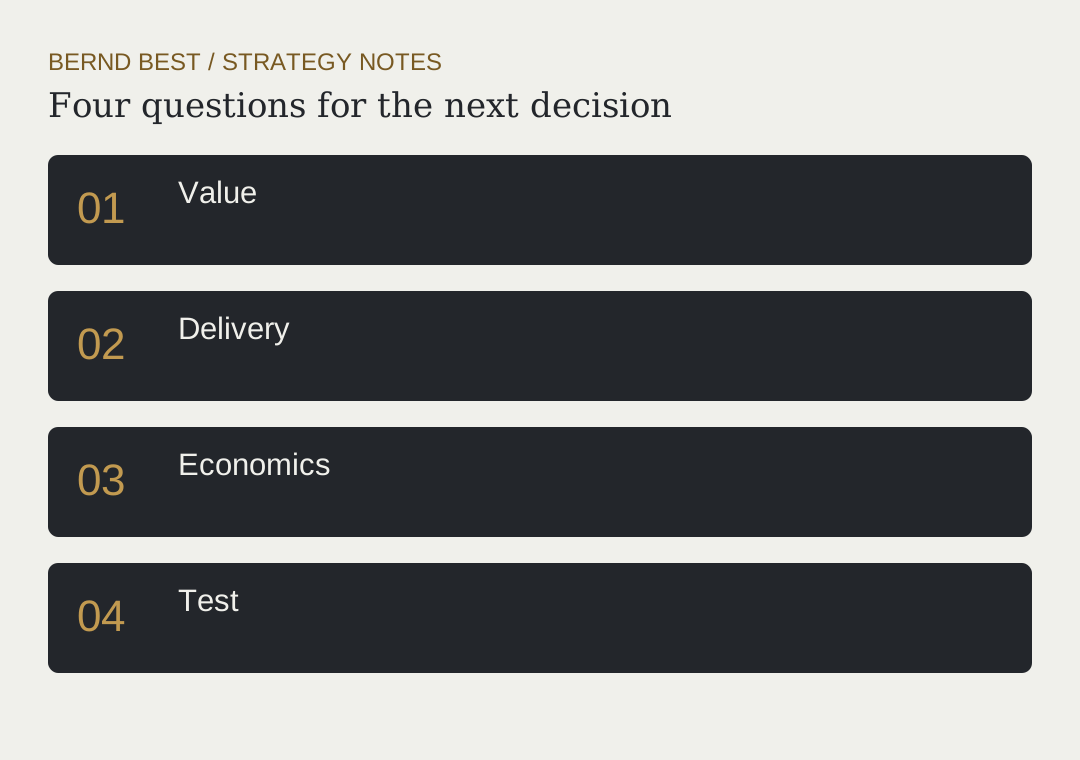
| Days 1 to 7 | Clarify value through one specific case. | A documented observation, not merely agreement. |
| Days 8 to 14 | Examine delivery with the responsible people. | An assumption and the evidence still missing. |
| Days 15 to 23 | Test economics within an agreed limit. | Recorded effects, workload and exceptions. |
| Days 24 to 30 | Decide the next step concerning test. | An owner, a date and a stopping rule. |
Use the timetable as a discussion aid and adjust it to the actual decision cycle. A manufacturing investment, a family handover and a short service test do not run on identical clocks. Do not infer improvement from completing tasks alone: check whether the decision became clearer and whether the effect appears in ordinary work. Keep a contrary observation in the review even when it complicates the original story.
US, UK, EU and DACH perspectives
A US lens may focus attention on buyer access and credible experiments; a UK lens can highlight governance and accountable decisions. An EU or German perspective adds the actual legal, industry and relationship context. These are useful questions, not national traits or a ranking. Austria and Switzerland warrant the same operating examination alongside their own local conditions. Begin with buyers, delivery and the constraint. Adopt a framework only if it makes a concrete choice easier to understand.
Frequently asked questions
How should I examine value?
Examine two building blocks together. A tailored service promise may conflict with a low-cost operating model.
How should I examine delivery?
Distinguish observation, interpretation and open question. A lost order is an observation.
How should I examine economics?
Choose the relationship whose clarification matters most to the next investment. Write down the decision it could change.
How should I examine test?
Keep dated versions with reasons for revisions. In an established company, a canvas should show changes in customers, partners or costs.
Which measure belongs in the review?
Begin with tested assumptions. Define the observation window, data source and owner before measuring. Compare similar cases, record exceptions and assess effects on customers and workload. The metric is a local learning aid, not a benchmark or guarantee.
When is this approach unsuitable?
Do not use this framework as a substitute for missing facts, a resolved mandate or required specialist review. Begin with one bounded decision. If the work cannot change a next action, narrow the question or choose a more suitable method.
Further reading
These primary sources provide background. The argument, working plan, illustrations and hypothetical case above are original editorial work. Sources checked October 10, 2026.
If a decision in your business still feels unclear, the short strategy check offers a starting point for a conversation. Open the strategy check.