Strategy Journal / 17
Strategy execution: the business sits between the decision and the calendar
Topic retrospective: 2025-12-01 · Published and updated: October 10, 2026. Written now; not an archived historical publication.
Strategy execution connects a reasoned choice with ownership, resources and recurring learning. A decision matters when it changes ordinary behavior. A few priorities with assigned capacity are often more useful than a long action list expected to fit around every existing commitment.
By Bernd Best · Original editorial analysis · Approximately 8 minutes
The decision
The move from a leadership retreat to Monday morning is a common weak point. Everyone agreed, but nobody stopped work or reassigned time. Execution begins by deciding what will be done differently and what will no longer continue, not by reminding people of the goal.
Working through the choice
Describe a priority as a choice
Do not simply call for better customer focus. Specify which buyers come first and which service must become dependable for them. A testable choice helps teams assess exceptions and explains why an attractive opportunity is not being pursued now.
Reassign capacity visibly
Every meaningful priority consumes time, money or attention. Show which existing activity will be reduced or stopped. Without that connection, the new direction becomes an added burden. A calendar entry is a start; protected working capacity makes results more realistic.
Connect ownership with support
An owner needs authority, information and accessible support. Clarify which obstacles they can resolve and which require leadership. Assigning a name without these conditions is not dependable ownership. Discuss effects and obstacles rather than personal busyness.
Use the rhythm for learning
A short recurring review examines assumptions, effects and the next step. It should not require the same presentation repeatedly. Evidence against the chosen route must allow reconsideration. Consistency means pursuing goals carefully, not defending a disproved path forever.
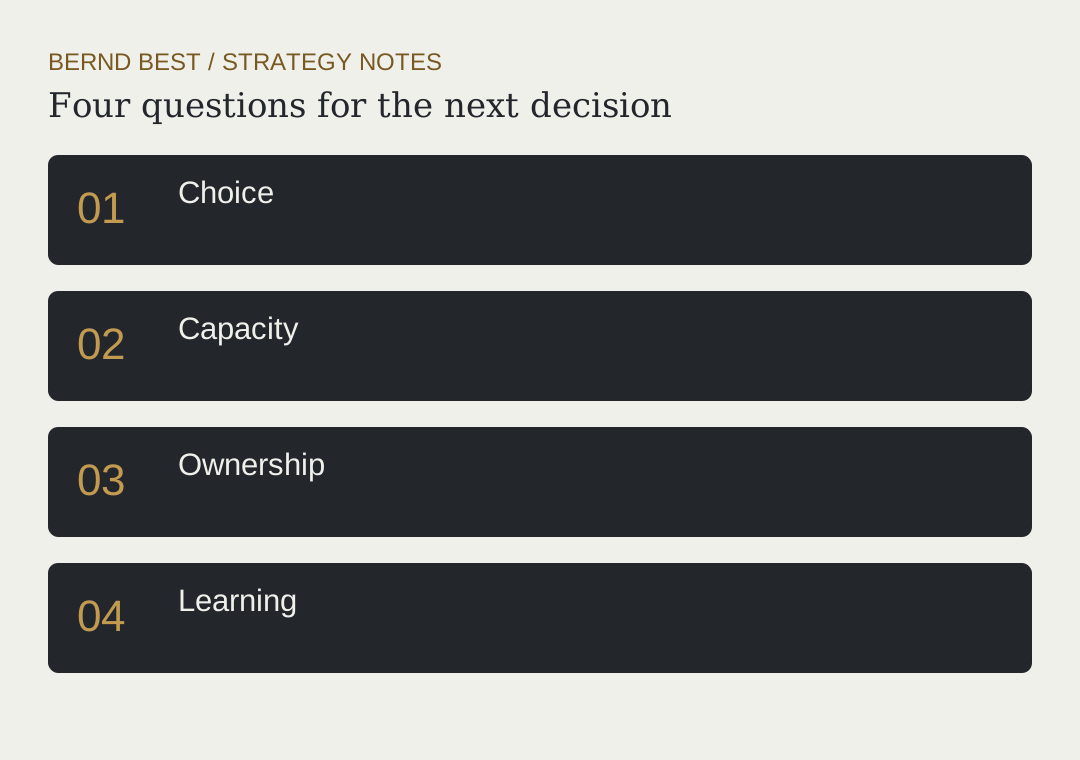
Illustrative case
Illustrative case: a company prioritizes dependable delivery dates for core customers. It stops a report without decision value and protects a weekly review of critical orders. Reviews examine delivery reliability and causes of variation. Strategy becomes visible in work, not merely in a heading.
A practical review
Starting measure: Completed choices with effects. Specify the unit, source, observation window and owner. Use comparable cases and keep exceptions visible.
| Period | Task | Evidence |
|---|---|---|
| Days 1 to 7 | Clarify choice through one specific case. | A documented observation, not merely agreement. |
| Days 8 to 14 | Examine capacity with the responsible people. | An assumption and the evidence still missing. |
| Days 15 to 23 | Test ownership within an agreed limit. | Recorded effects, workload and exceptions. |
| Days 24 to 30 | Decide the next step concerning learning. | An owner, a date and a stopping rule. |
Use the timetable as a discussion aid and adjust it to the actual decision cycle. A manufacturing investment, a family handover and a short service test do not run on identical clocks. Do not infer improvement from completing tasks alone: check whether the decision became clearer and whether the effect appears in ordinary work. Keep a contrary observation in the review even when it complicates the original story.
US, UK, EU and DACH perspectives
A US lens may focus attention on buyer access and credible experiments; a UK lens can highlight governance and accountable decisions. An EU or German perspective adds the actual legal, industry and relationship context. These are useful questions, not national traits or a ranking. Austria and Switzerland warrant the same operating examination alongside their own local conditions. Begin with buyers, delivery and the constraint. Adopt a framework only if it makes a concrete choice easier to understand.
Frequently asked questions
How should I examine choice?
Do not simply call for better customer focus. Specify which buyers come first and which service must become dependable for them.
How should I examine capacity?
Every meaningful priority consumes time, money or attention. Show which existing activity will be reduced or stopped.
How should I examine ownership?
An owner needs authority, information and accessible support. Clarify which obstacles they can resolve and which require leadership.
How should I examine learning?
A short recurring review examines assumptions, effects and the next step. It should not require the same presentation repeatedly.
Which measure belongs in the review?
Begin with completed choices with effects. Define the observation window, data source and owner before measuring. Compare similar cases, record exceptions and assess effects on customers and workload. The metric is a local learning aid, not a benchmark or guarantee.
When is this approach unsuitable?
Do not use this framework as a substitute for missing facts, a resolved mandate or required specialist review. Begin with one bounded decision. If the work cannot change a next action, narrow the question or choose a more suitable method.
Further reading
These primary sources provide background. The argument, working plan, illustrations and hypothetical case above are original editorial work. Sources checked October 10, 2026.
If a decision in your business still feels unclear, the short strategy check offers a starting point for a conversation. Open the strategy check.