Strategy Journal / 15
B2B sales strategy: another meeting is not necessarily progress
Topic retrospective: 2025-07-07 · Published and updated: October 10, 2026. Written now; not an archived historical publication.
B2B sales supports decisions involving multiple people, risks and approvals. A strategy connects suitable buyers with an understandable purchasing process. It looks beyond contacts and meetings to changes on the buyer’s side: clearer problems, agreed conditions and a meaningful next action.
By Bernd Best · Original editorial analysis · Approximately 8 minutes
The decision
A busy pipeline may contain many cordial conversations and little buying intent. Counting every activity as progress produces weak capacity planning. Specify which buyer action confirms a stage. A jointly agreed evaluation step means more than a follow-up date selected by the seller alone.
Working through the choice
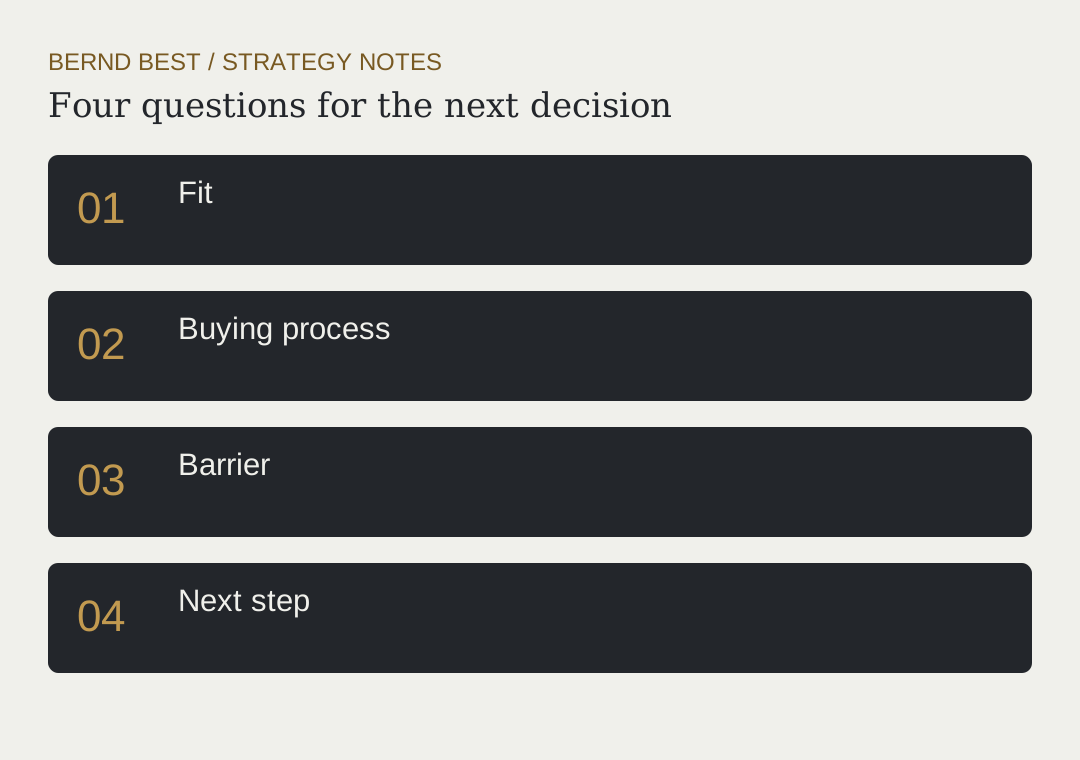
Check fit before reach
Define the problem, context and delivery requirements of core buyers. A large list helps little when every prospect needs a different service. Examine won and lost cases for comparable conditions. Selection should fit the offer and avoid improper data use or assumptions about personal traits.
Clarify the purchasing process together
Ask who participates, which criteria matter and what currently prevents a decision. This is not an interrogation checklist. Good clarification helps buyers organize their own work. If the process remains unknown, record that uncertainty rather than inventing a confident closing date.
Choose content for the decision barrier
Clear scope helps with scope questions; a transparent pilot plan helps with uncertainty. Another general presentation may not resolve an internal approval conflict. Select material for the specific barrier and agree which question it should answer. A document is a working tool, not a substitute for progress.
Follow up for an agreed reason
Agree on timing, channel and purpose for the next contact. Distinguish responding to an enquiry from ongoing marketing. A respectful closure can be better than endless meaningless reminders. Record why a suitable opportunity stops where the buyer voluntarily shares that information.
Illustrative case
Illustrative case: a service company replaces proposal sent with scope and review date jointly confirmed. Delivering a document no longer counts as equivalent progress. The pipeline initially becomes smaller but clearer. This is no revenue promise; it improves the basis for capacity planning and conversations.
A practical review
Starting measure: Confirmed buyer actions. Specify the unit, source, observation window and owner. Use comparable cases and keep exceptions visible.
| Period | Task | Evidence |
|---|---|---|
| Days 1 to 7 | Clarify fit through one specific case. | A documented observation, not merely agreement. |
| Days 8 to 14 | Examine buying process with the responsible people. | An assumption and the evidence still missing. |
| Days 15 to 23 | Test barrier within an agreed limit. | Recorded effects, workload and exceptions. |
| Days 24 to 30 | Decide the next step concerning next step. | An owner, a date and a stopping rule. |
Use the timetable as a discussion aid and adjust it to the actual decision cycle. A manufacturing investment, a family handover and a short service test do not run on identical clocks. Do not infer improvement from completing tasks alone: check whether the decision became clearer and whether the effect appears in ordinary work. Keep a contrary observation in the review even when it complicates the original story.
US, UK, EU and DACH perspectives
A US lens may focus attention on buyer access and credible experiments; a UK lens can highlight governance and accountable decisions. An EU or German perspective adds the actual legal, industry and relationship context. These are useful questions, not national traits or a ranking. Austria and Switzerland warrant the same operating examination alongside their own local conditions. Begin with buyers, delivery and the constraint. Adopt a framework only if it makes a concrete choice easier to understand.
Frequently asked questions
How should I examine fit?
Define the problem, context and delivery requirements of core buyers. A large list helps little when every prospect needs a different service.
How should I examine buying process?
Ask who participates, which criteria matter and what currently prevents a decision. This is not an interrogation checklist.
How should I examine barrier?
Clear scope helps with scope questions; a transparent pilot plan helps with uncertainty. Another general presentation may not resolve an internal approval conflict.
How should I examine next step?
Agree on timing, channel and purpose for the next contact. Distinguish responding to an enquiry from ongoing marketing.
Which measure belongs in the review?
Begin with confirmed buyer actions. Define the observation window, data source and owner before measuring. Compare similar cases, record exceptions and assess effects on customers and workload. The metric is a local learning aid, not a benchmark or guarantee.
When is this approach unsuitable?
Do not use this framework as a substitute for missing facts, a resolved mandate or required specialist review. Begin with one bounded decision. If the work cannot change a next action, narrow the question or choose a more suitable method.
Further reading
These primary sources provide background. The argument, working plan, illustrations and hypothetical case above are original editorial work. Sources checked October 10, 2026.
If a decision in your business still feels unclear, the short strategy check offers a starting point for a conversation. Open the strategy check.