Strategy Journal / 20
Resilience strategy: practical readiness without permanent alarm
Topic retrospective: 2026-07-06 · Published and updated: October 10, 2026. Written now; not an archived historical publication.
Resilience means sustaining important services under changed conditions or restoring them in an orderly way. It requires known dependencies, suitable alternatives and clear decisions during disruption. A resilient company need not answer every imaginable risk with an expensive reserve.
By Bernd Best · Original editorial analysis · Approximately 8 minutes
The decision
Risk lists become long quickly and actionable slowly. Begin with services whose interruption most affects buyers and operations. Trace the people, information and suppliers required. Priority depends on consequences and recoverability, not simply on how dramatic a scenario sounds.
Working through the choice
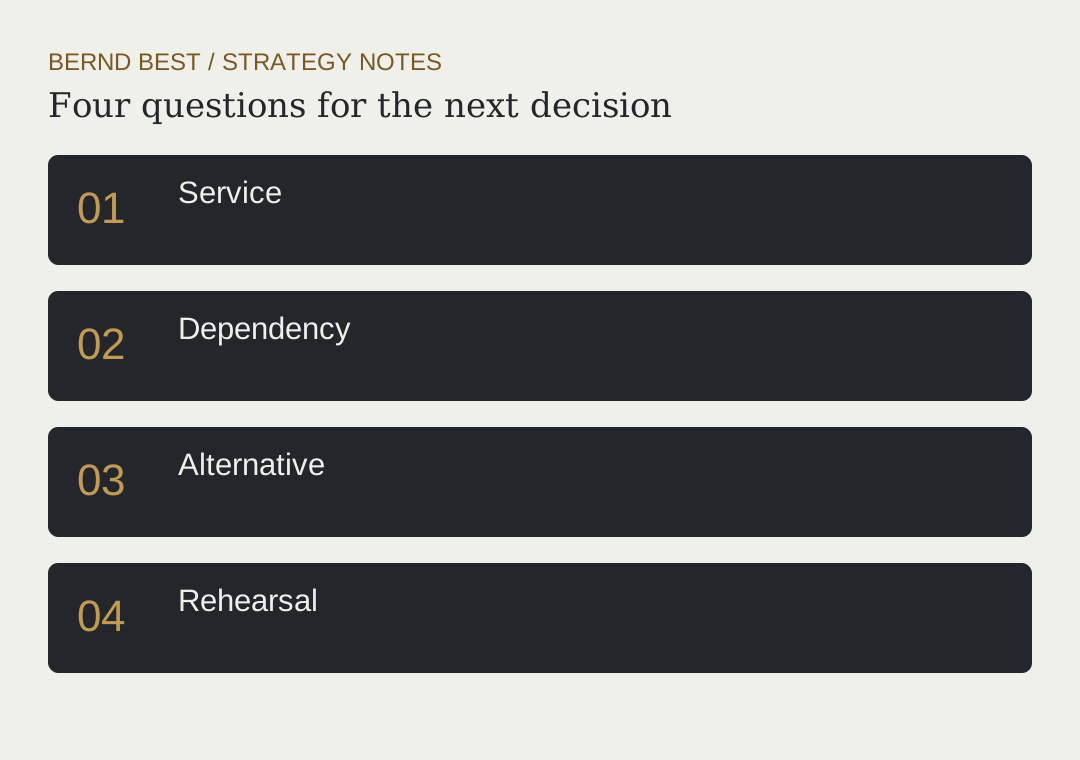
Make critical dependencies visible
An important capability may depend on one person, file or supplier. Examine what would actually become impossible if it were unavailable. Distinguish inconvenience from serious interruption. This helps direct limited resources toward failures that are particularly difficult to recover from.
Test alternatives under real conditions
A list of possible suppliers is not yet a working alternative. Examine suitability, capacity and switching effort. A backup becomes useful when restoration has been tested. The required depth depends on the critical service. Begin with a bounded exercise rather than a sweeping claim of readiness.
Prepare disruption decisions
Specify who assesses an interruption, informs customers and decides priorities. A short process may be enough if it is understood and contacts are current. Rehearse a plausible situation. The exercise should uncover ambiguity rather than produce an impressive picture of readiness.
Make the cost of resilience explicit
Extra inventory, duplicate skills and available alternatives consume money or time. Compare that burden with disruption consequences and reassess changed conditions. Resilience is a deliberate economic choice, not a reason to defend every inefficient habit as a necessary reserve.
Illustrative case
Illustrative case: a small company discovers that only one person can prepare critical shipping documents. It records the process and rehearses it with a second person. This requires planned working time rather than a large new platform. Results are assessed in a suitable real case, not inferred from the completed manual.
A practical review
Starting measure: Tested recovery capability. Specify the unit, source, observation window and owner. Use comparable cases and keep exceptions visible.
| Period | Task | Evidence |
|---|---|---|
| Days 1 to 7 | Clarify service through one specific case. | A documented observation, not merely agreement. |
| Days 8 to 14 | Examine dependency with the responsible people. | An assumption and the evidence still missing. |
| Days 15 to 23 | Test alternative within an agreed limit. | Recorded effects, workload and exceptions. |
| Days 24 to 30 | Decide the next step concerning rehearsal. | An owner, a date and a stopping rule. |
Use the timetable as a discussion aid and adjust it to the actual decision cycle. A manufacturing investment, a family handover and a short service test do not run on identical clocks. Do not infer improvement from completing tasks alone: check whether the decision became clearer and whether the effect appears in ordinary work. Keep a contrary observation in the review even when it complicates the original story.
US, UK, EU and DACH perspectives
A US lens may focus attention on buyer access and credible experiments; a UK lens can highlight governance and accountable decisions. An EU or German perspective adds the actual legal, industry and relationship context. These are useful questions, not national traits or a ranking. Austria and Switzerland warrant the same operating examination alongside their own local conditions. Begin with buyers, delivery and the constraint. Adopt a framework only if it makes a concrete choice easier to understand.
Frequently asked questions
How should I examine service?
An important capability may depend on one person, file or supplier. Examine what would actually become impossible if it were unavailable.
How should I examine dependency?
A list of possible suppliers is not yet a working alternative. Examine suitability, capacity and switching effort.
How should I examine alternative?
Specify who assesses an interruption, informs customers and decides priorities. A short process may be enough if it is understood and contacts are current.
How should I examine rehearsal?
Extra inventory, duplicate skills and available alternatives consume money or time. Compare that burden with disruption consequences and reassess changed conditions.
Which measure belongs in the review?
Begin with tested recovery capability. Define the observation window, data source and owner before measuring. Compare similar cases, record exceptions and assess effects on customers and workload. The metric is a local learning aid, not a benchmark or guarantee.
When is this approach unsuitable?
Do not use this framework as a substitute for missing facts, a resolved mandate or required specialist review. Begin with one bounded decision. If the work cannot change a next action, narrow the question or choose a more suitable method.
Further reading
These primary sources provide background. The argument, working plan, illustrations and hypothetical case above are original editorial work. Sources checked October 10, 2026.
If a decision in your business still feels unclear, the short strategy check offers a starting point for a conversation. Open the strategy check.