Strategy Journal / 05
First generation: let the business become independent of its founder
Topic retrospective: 2022-10-10 · Published and updated: October 10, 2026. Written now; not an archived historical publication.
A founder-led business becomes transferable when important decisions remain sound without the founder in the room. That does not require erasing its history. The next generation needs access to buying reasons, boundaries and decision logic. Personal knowledge must become a capability others can use.
By Bernd Best · Original editorial analysis · Approximately 8 minutes

The decision
The founder may recognize exceptions, customers and risks faster than any document. That knowledge has been an advantage. During transfer it becomes a constraint if nobody can explain the reasoning behind decisions. The answer is not documenting every day; it is clarifying the most important recurring choices.
Working through the choice
Transfer reasoning, not a scrapbook
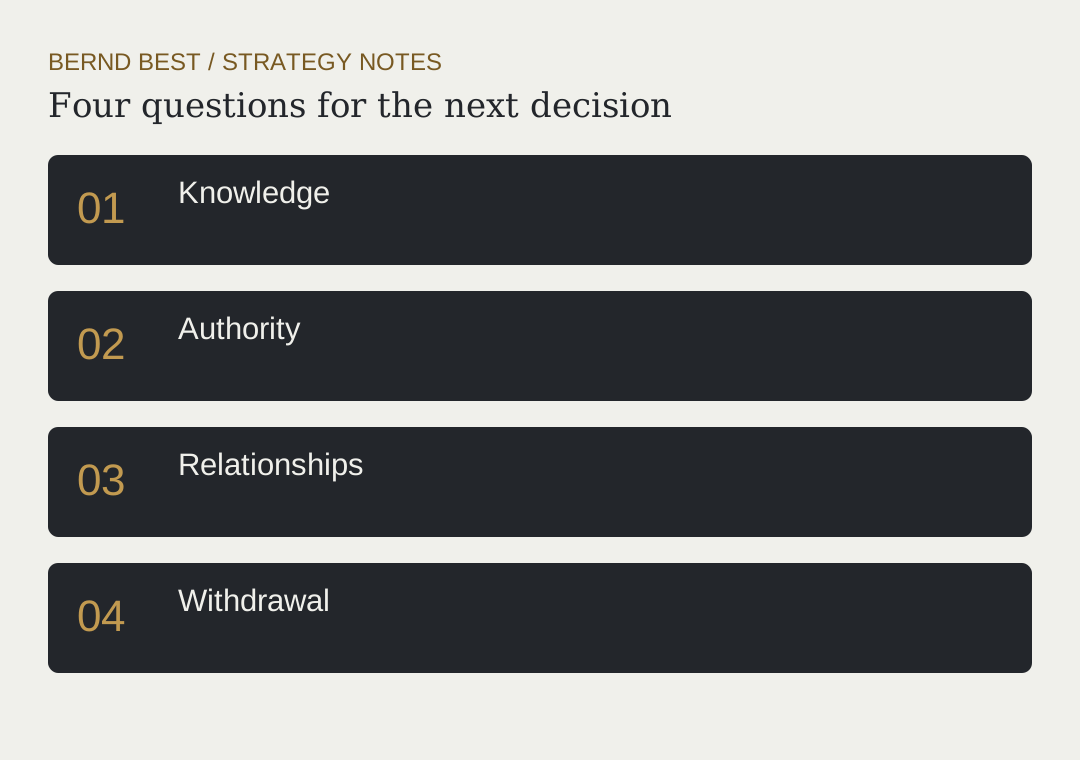
Select ten recurring decisions and record their triggers, limits and reasoning. Ask which past experience shaped each rule. A useful handover explains what happens and when a rule may be changed.
Delegation requires actual room
Responsibility remains symbolic if the founder reclaims every exception. Agree spending or risk limits and reporting arrangements. Inside those limits, the successor decides. A bounded mistake can support learning; quietly reversing decisions undermines ownership.
Transfer customer relationships together
Start with important customers before announcing a role change. Joint meetings should make the future responsibility clear. The next contact must then actually go through the new person. Otherwise, every friendly call to the founder reinforces the old dependency.
Leaving is a separate responsibility
Define a useful role outside the operating decision path. It may involve knowledge transfer, a board role or personal projects. Advice is not concealed authority. Agree how serious risks can be raised without bypassing the new leadership.
Illustrative case
Illustrative manufacturer: special pricing depends on the founder. During transition, she first explains the existing boundaries. The successor then decides independently within an agreed range. A monthly review examines reasoning and outcomes. Customers experience one dependable counterpart rather than two competing promises.
A practical review
Starting measure: Decisions without escalation. Specify the unit, source, observation window and owner. Use comparable cases and keep exceptions visible.
| Period | Task | Evidence |
|---|---|---|
| Days 1 to 7 | Clarify knowledge through one specific case. | A documented observation, not merely agreement. |
| Days 8 to 14 | Examine authority with the responsible people. | An assumption and the evidence still missing. |
| Days 15 to 23 | Test relationships within an agreed limit. | Recorded effects, workload and exceptions. |
| Days 24 to 30 | Decide the next step concerning withdrawal. | An owner, a date and a stopping rule. |
Use the timetable as a discussion aid and adjust it to the actual decision cycle. A manufacturing investment, a family handover and a short service test do not run on identical clocks. Do not infer improvement from completing tasks alone: check whether the decision became clearer and whether the effect appears in ordinary work. Keep a contrary observation in the review even when it complicates the original story.
US, UK, EU and DACH perspectives
A US lens often emphasizes the operating leadership role; a UK lens distinguishes responsibilities of owners and boards. European and German family businesses add established relationships, legal structures and participation rights. These are questions to examine, not descriptions of every company in a country. Austria and Switzerland have their own corporate, tax and employment frameworks. A handover plan must fit the actual business. Borrow a useful leadership question, but do not import another country’s legal structure without suitable professional review.
Frequently asked questions
How should I examine knowledge?
Select ten recurring decisions and record their triggers, limits and reasoning. Ask which past experience shaped each rule.
How should I examine authority?
Responsibility remains symbolic if the founder reclaims every exception. Agree spending or risk limits and reporting arrangements.
How should I examine relationships?
Start with important customers before announcing a role change. Joint meetings should make the future responsibility clear.
How should I examine withdrawal?
Define a useful role outside the operating decision path. It may involve knowledge transfer, a board role or personal projects.
Which measure belongs in the review?
Begin with decisions without escalation. Define the observation window, data source and owner before measuring. Compare similar cases, record exceptions and assess effects on customers and workload. The metric is a local learning aid, not a benchmark or guarantee.
When is this approach unsuitable?
Do not use this framework as a substitute for missing facts, a resolved mandate or required specialist review. Begin with one bounded decision. If the work cannot change a next action, narrow the question or choose a more suitable method.
Further reading
These primary sources provide background. The argument, working plan, illustrations and hypothetical case above are original editorial work. Sources checked October 10, 2026.
If a decision in your business still feels unclear, the short strategy check offers a starting point for a conversation. Open the strategy check.