Strategy Journal / 10
Cash and strategy: why a full order book is not enough
Topic retrospective: 2024-04-08 · Published and updated: October 10, 2026. Written now; not an archived historical publication.
Strategic choices change when cash leaves a business and when it returns. Growth, payment terms and inventory can require cash before profit appears. An order book becomes useful only when considered alongside payment timing, obligations and available financing.
By Bernd Best · Original editorial analysis · Approximately 8 minutes

The decision
An attractive margin does not automatically prevent a cash shortage. A business funding materials and labor upfront needs different controls from one receiving advance payments. Look beyond the income plan and trace a typical order from purchasing to cash actually received.
Working through the choice
View the order as a timeline
Mark major cash outflows, evidence of completion and invoice dates. Include realistic delays rather than relying exclusively on contractual dates. Missing acceptance can postpone payment after a product is finished. The constraint may concern documentation rather than sales.
Consider buyers and suppliers together
Longer customer terms and shorter supplier terms act at the same time. Examine conditions by order type and negotiating room. Changes frequently need agreement with counterparties and professional advice. The economics must include promised service, fair relationships and applicable legal limits.
Sort growth by funding demand
Two orders with identical revenue can require very different amounts of upfront funding. Identify materials, duration and uncertainty of cash collection. This supports prioritization and financing discussions. It complements an agreed cash plan by connecting growth ambitions with payment consequences early.
Connect short-term visibility with long-term choices
A rolling view should show expected receipts and payments, assumptions and owners. Compare plans with actual cash received. Repeated differences belong in strategy: is scope too open, acceptance too late or the customer mix unsuitable? Cash becomes a learning signal as well as an operating concern.
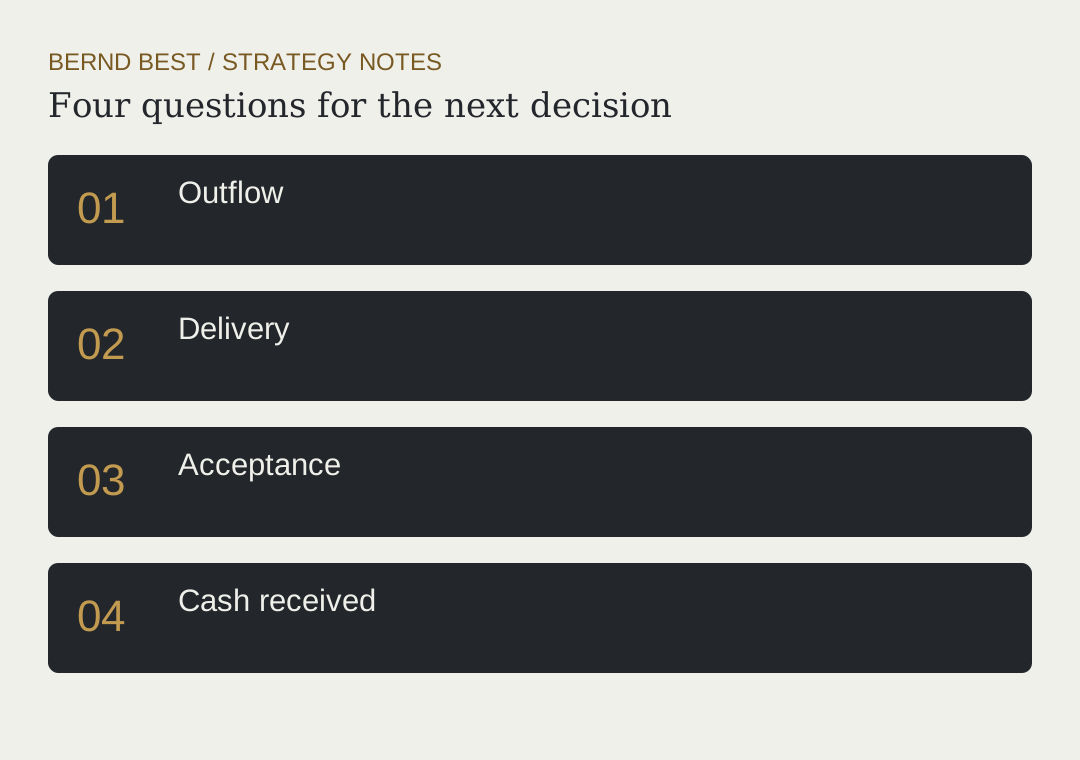
Illustrative case
Illustrative arithmetic: an order produces 100 units of revenue. Materials costing 60 units are paid before work starts, and another 20 units fall due during delivery. The customer pays after acceptance. Even with a positive result, 80 units are temporarily tied up. These figures explain a mechanism; they are neither a benchmark nor financing advice.
A practical review
Starting measure: Funding required per order. Specify the unit, source, observation window and owner. Use comparable cases and keep exceptions visible.
| Period | Task | Evidence |
|---|---|---|
| Days 1 to 7 | Clarify outflow through one specific case. | A documented observation, not merely agreement. |
| Days 8 to 14 | Examine delivery with the responsible people. | An assumption and the evidence still missing. |
| Days 15 to 23 | Test acceptance within an agreed limit. | Recorded effects, workload and exceptions. |
| Days 24 to 30 | Decide the next step concerning cash received. | An owner, a date and a stopping rule. |
Use the timetable as a discussion aid and adjust it to the actual decision cycle. A manufacturing investment, a family handover and a short service test do not run on identical clocks. Do not infer improvement from completing tasks alone: check whether the decision became clearer and whether the effect appears in ordinary work. Keep a contrary observation in the review even when it complicates the original story.
US, UK, EU and DACH perspectives
Economic mechanisms may be comparable across the US, UK, EU and DACH while tax, contractual and financing conditions differ. Compare the same operating situation first, then assess local requirements. A payment term or offer structure useful in one setting will not automatically suit every market. Legal, tax and financing review remain separate professional tasks. The examples explain strategic choices and contain no individual investment or financing recommendation.
Frequently asked questions
How should I examine outflow?
Mark major cash outflows, evidence of completion and invoice dates. Include realistic delays rather than relying exclusively on contractual dates.
How should I examine delivery?
Longer customer terms and shorter supplier terms act at the same time. Examine conditions by order type and negotiating room.
How should I examine acceptance?
Two orders with identical revenue can require very different amounts of upfront funding. Identify materials, duration and uncertainty of cash collection.
How should I examine cash received?
A rolling view should show expected receipts and payments, assumptions and owners. Compare plans with actual cash received.
Which measure belongs in the review?
Begin with funding required per order. Define the observation window, data source and owner before measuring. Compare similar cases, record exceptions and assess effects on customers and workload. The metric is a local learning aid, not a benchmark or guarantee.
When is this approach unsuitable?
Do not use this framework as a substitute for missing facts, a resolved mandate or required specialist review. Begin with one bounded decision. If the work cannot change a next action, narrow the question or choose a more suitable method.
Further reading
These primary sources provide background. The argument, working plan, illustrations and hypothetical case above are original editorial work. Sources checked October 10, 2026.
If a decision in your business still feels unclear, the short strategy check offers a starting point for a conversation. Open the strategy check.