Strategy Journal / 19
International expansion: the US, UK and EU are not a translation exercise
Topic retrospective: 2026-04-13 · Published and updated: October 10, 2026. Written now; not an archived historical publication.
International expansion changes buyer access, contracts, delivery and economic assumptions. Translation helps communication but cannot replace a market choice. Test a specific entry case: one buyer type, one offer, one channel and a dependable path to delivery and payment.
By Bernd Best · Original editorial analysis · Approximately 8 minutes

The decision
Large market figures can hide practical differences. US states, UK rules and the EU single market present distinct conditions. Germany, Austria and Switzerland are not identical in every respect either. Avoid cultural stereotypes and examine the actual purchasing and delivery process in the chosen segment.
Working through the choice
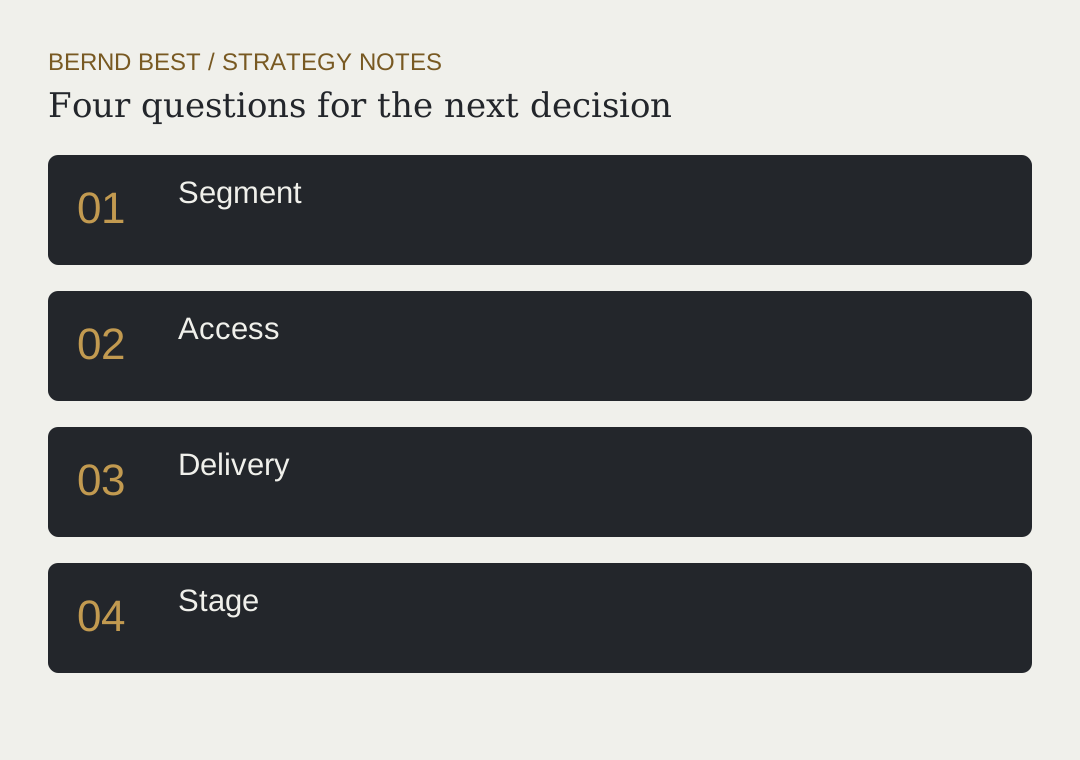
Choose a segment before a country
A country is not one homogeneous buyer. Define the industry, situation and access route for the first test. Ask which specific customer can buy and use the offer reliably. Use relevant conversations and official market-access information rather than treating national stereotypes as a sales strategy.
Map the complete delivery route
Review language, time zones, support, returns and payment handling. Goods may add customs, product requirements and import questions. Services may raise licensing, tax or data-transfer issues. Applicable rules depend on the offer and operating structure and need current official sources and suitable advice.
Compare partners with direct access
A partner can provide access and local capability while changing margin, customer proximity and dependence. Direct sales offer different opportunities and obligations. Compare both through a specific order. Clarify customer responsibility, information and exit arrangements before early success turns into an unexamined permanent arrangement.
Stage the entry
Define scope, a spending boundary and decision-relevant signals. One good conversation does not justify an office. Repeated reliable delivery may support the next step. Include effects on existing customers; expansion should not quietly consume their promised service or rely on them to subsidize it.
Illustrative case
Illustrative case: a German B2B service company tests UK buyers in a familiar industry. It starts with a bounded project, obtains suitable contract and data-processing review and plans support hours. The decision on sustained entry follows examination of delivery, demand and actual contribution.
A practical review
Starting measure: Repeatable overseas delivery. Specify the unit, source, observation window and owner. Use comparable cases and keep exceptions visible.
| Period | Task | Evidence |
|---|---|---|
| Days 1 to 7 | Clarify segment through one specific case. | A documented observation, not merely agreement. |
| Days 8 to 14 | Examine access with the responsible people. | An assumption and the evidence still missing. |
| Days 15 to 23 | Test delivery within an agreed limit. | Recorded effects, workload and exceptions. |
| Days 24 to 30 | Decide the next step concerning stage. | An owner, a date and a stopping rule. |
Use the timetable as a discussion aid and adjust it to the actual decision cycle. A manufacturing investment, a family handover and a short service test do not run on identical clocks. Do not infer improvement from completing tasks alone: check whether the decision became clearer and whether the effect appears in ordinary work. Keep a contrary observation in the review even when it complicates the original story.
US, UK, EU and DACH perspectives
Treat the US, UK and EU as distinct settings for assessment. Market access, product requirements, contracts and data obligations depend on the industry and offer. The EU facilitates some cross-border activity without eliminating every national difference; Switzerland needs separate consideration. Even a neighboring market can create a new operating situation when delivery or support changes. Consult current official information and suitable local expertise before transferring contractual or tax assumptions from the home market.
Frequently asked questions
How should I examine segment?
A country is not one homogeneous buyer. Define the industry, situation and access route for the first test.
How should I examine access?
Review language, time zones, support, returns and payment handling. Goods may add customs, product requirements and import questions.
How should I examine delivery?
A partner can provide access and local capability while changing margin, customer proximity and dependence. Direct sales offer different opportunities and obligations.
How should I examine stage?
Define scope, a spending boundary and decision-relevant signals. One good conversation does not justify an office.
Which measure belongs in the review?
Begin with repeatable overseas delivery. Define the observation window, data source and owner before measuring. Compare similar cases, record exceptions and assess effects on customers and workload. The metric is a local learning aid, not a benchmark or guarantee.
When is this approach unsuitable?
Do not use this framework as a substitute for missing facts, a resolved mandate or required specialist review. Begin with one bounded decision. If the work cannot change a next action, narrow the question or choose a more suitable method.
Further reading
These primary sources provide background. The argument, working plan, illustrations and hypothetical case above are original editorial work. Sources checked October 10, 2026.
If a decision in your business still feels unclear, the short strategy check offers a starting point for a conversation. Open the strategy check.