Strategy Journal / 12
Pricing strategy: the work begins before the number
Topic retrospective: 2024-10-14 · Published and updated: October 10, 2026. Written now; not an archived historical publication.
Pricing strategy connects customer value, scope and economics. It cannot be built solely by watching competitors’ prices. A company needs to understand buyer alternatives, included services and exceptions that consume contribution. Only then can it assess a price choice usefully.
By Bernd Best · Original editorial analysis · Approximately 8 minutes

The decision
Discounts act quickly because their effect on the quoted price is immediately visible. Their consequences for capacity, promised service and future negotiation are less obvious. Start by examining the offer. Ambiguous scope can undo any improvement in the number.
Working through the choice
Assess value without imaginary economics
Ask about the current alternative and the consequences of the problem. Less downtime or fewer handoffs may matter. Do not claim monetary benefits you cannot explain credibly. The buyer’s perspective and internal decision process matter more than a generous value calculation on your sales slide.
Make scope boundaries visible
Separate the core service, optional additions and genuine exceptions. Specify when extra work arises and how it will be agreed. Clear boundaries protect trust by aligning expectations. Charging more for the same ambiguous promise does not remove the cause of economic uncertainty.
Use an appropriate comparison
Compare similar cases and record differences in scope, buyers and negotiation. A lost order does not automatically prove the price was too high. Examine the decision reason where the buyer shares it. Tests need fair terms and compliance with applicable pricing, competition and consumer rules.
Assign responsibility for negotiation
Define what can justify a concession, such as reduced scope or more predictable timing. An exception needs an owner and a reason. Sales should retain room to act without turning every special arrangement into a new price standard. Review recurring exceptions in the management rhythm.
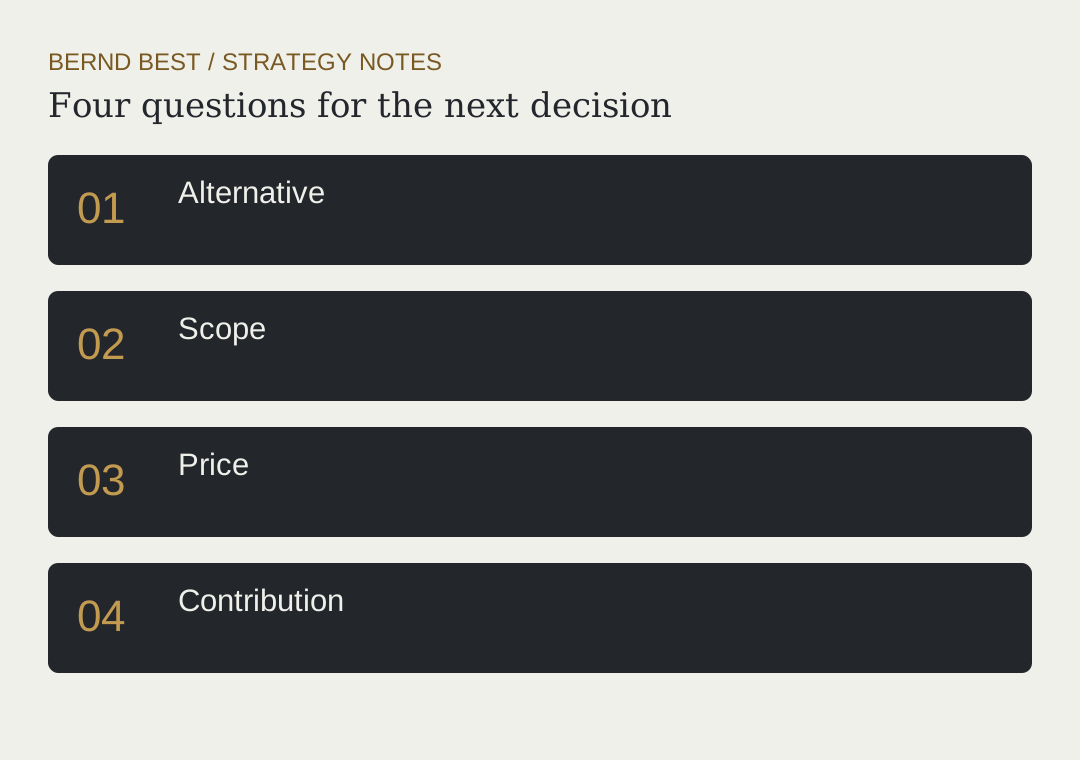
Illustrative case
Illustrative case: an agency separates a defined project from ongoing support. Previously, repeated coordination was quietly included. It reviews not only win rates but also rework and contribution per project. The team can see whether pricing improves economics or merely creates new expectations.
A practical review
Starting measure: Contribution after extra work. Specify the unit, source, observation window and owner. Use comparable cases and keep exceptions visible.
| Period | Task | Evidence |
|---|---|---|
| Days 1 to 7 | Clarify alternative through one specific case. | A documented observation, not merely agreement. |
| Days 8 to 14 | Examine scope with the responsible people. | An assumption and the evidence still missing. |
| Days 15 to 23 | Test price within an agreed limit. | Recorded effects, workload and exceptions. |
| Days 24 to 30 | Decide the next step concerning contribution. | An owner, a date and a stopping rule. |
Use the timetable as a discussion aid and adjust it to the actual decision cycle. A manufacturing investment, a family handover and a short service test do not run on identical clocks. Do not infer improvement from completing tasks alone: check whether the decision became clearer and whether the effect appears in ordinary work. Keep a contrary observation in the review even when it complicates the original story.
US, UK, EU and DACH perspectives
Economic mechanisms may be comparable across the US, UK, EU and DACH while tax, contractual and financing conditions differ. Compare the same operating situation first, then assess local requirements. A payment term or offer structure useful in one setting will not automatically suit every market. Legal, tax and financing review remain separate professional tasks. The examples explain strategic choices and contain no individual investment or financing recommendation.
Frequently asked questions
How should I examine alternative?
Ask about the current alternative and the consequences of the problem. Less downtime or fewer handoffs may matter.
How should I examine scope?
Separate the core service, optional additions and genuine exceptions. Specify when extra work arises and how it will be agreed.
How should I examine price?
Compare similar cases and record differences in scope, buyers and negotiation. A lost order does not automatically prove the price was too high.
How should I examine contribution?
Define what can justify a concession, such as reduced scope or more predictable timing. An exception needs an owner and a reason.
Which measure belongs in the review?
Begin with contribution after extra work. Define the observation window, data source and owner before measuring. Compare similar cases, record exceptions and assess effects on customers and workload. The metric is a local learning aid, not a benchmark or guarantee.
When is this approach unsuitable?
Do not use this framework as a substitute for missing facts, a resolved mandate or required specialist review. Begin with one bounded decision. If the work cannot change a next action, narrow the question or choose a more suitable method.
Further reading
These primary sources provide background. The argument, working plan, illustrations and hypothetical case above are original editorial work. Sources checked October 10, 2026.
If a decision in your business still feels unclear, the short strategy check offers a starting point for a conversation. Open the strategy check.