Strategy Journal / 11
Growth strategy: understand the limit before enlarging the market
Topic retrospective: 2024-07-01 · Published and updated: October 10, 2026. Written now; not an archived historical publication.
Growth is a choice about more customers, different offers or new markets. Each route requires different capabilities. A useful growth strategy first identifies the current business constraint. Otherwise the company scales unreliable delivery, unsuitable orders or excessive service demands.
By Bernd Best · Original editorial analysis · Approximately 8 minutes

The decision
More demand looks appealing while its side effects remain abstract. Ask what would happen if twice as many suitable orders arrived next week. The answer reveals limits in acquisition, capacity, knowledge or cash. A growth target without this check mainly announces a heavier workload.
Working through the choice
Compare growth routes separately
Selling more of an existing offer to current customers differs from entering a new market with a new service. Record buyer access, capabilities and central uncertainty for each route. A simple comparison prevents familiar and unfamiliar risks from disappearing inside one revenue total.
Define suitable demand
An additional order is not automatically good growth. It may consume capacity needed by core customers or fill the team’s time with exceptions. Define minimum fit through scope, deliverability and contribution. Sales and operations need the same definition to keep added demand from becoming an internal dispute about quality.
Bound the next step
Select a defined expansion whose effects can be observed, such as one additional buyer type within a familiar region. Decide which existing service must be protected and when the expansion would stop. Growth deserves the same care as initial market entry.
Manage capacity as a strategic resource
Plan the work new people would own, not just additional positions. Another employee cannot solve an unclear approval process. Examine workflow, responsibility and priorities first. A small operating change may then help more than a large hire without making permanent overload the business model.
Illustrative case
Illustrative case: a service company wants national expansion. Experienced technicians already spend too much time handling clarification. Before opening a new region, it establishes complete job information and a clear escalation path. Once the existing region operates reliably, it tests a second with a bounded scope.
A practical review
Starting measure: Contribution from suitable orders. Specify the unit, source, observation window and owner. Use comparable cases and keep exceptions visible.
| Period | Task | Evidence |
|---|---|---|
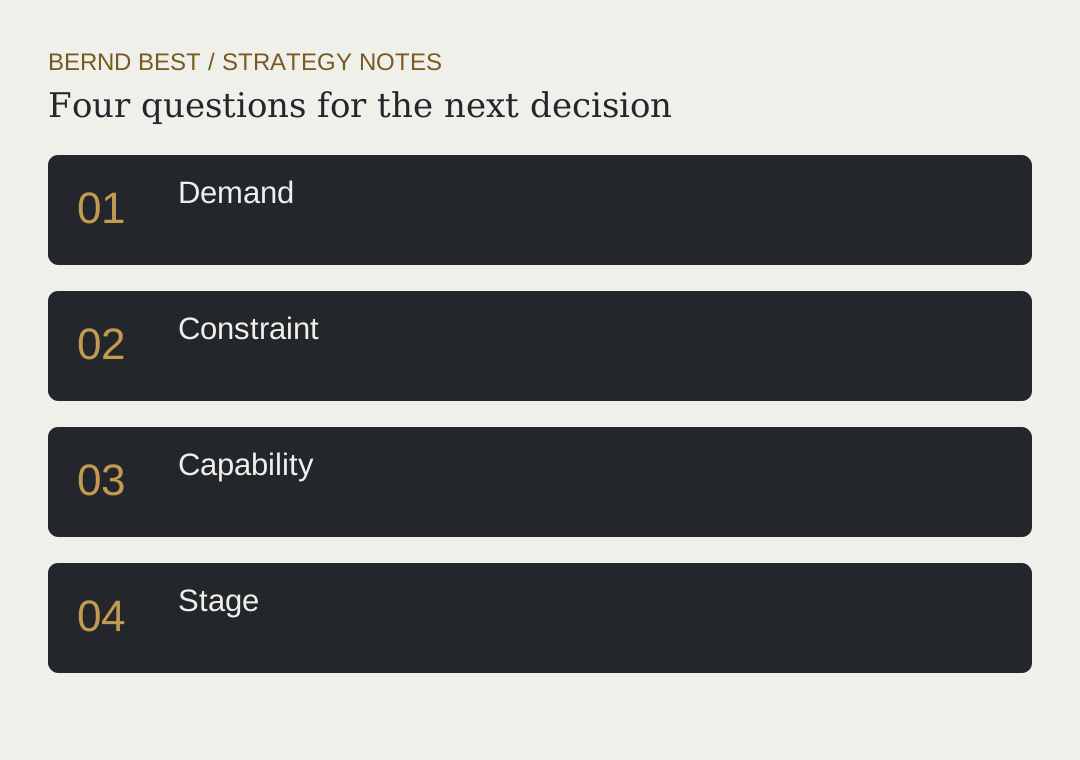
| Days 1 to 7 | Clarify demand through one specific case. | A documented observation, not merely agreement. |
| Days 8 to 14 | Examine constraint with the responsible people. | An assumption and the evidence still missing. |
| Days 15 to 23 | Test capability within an agreed limit. | Recorded effects, workload and exceptions. |
| Days 24 to 30 | Decide the next step concerning stage. | An owner, a date and a stopping rule. |
Use the timetable as a discussion aid and adjust it to the actual decision cycle. A manufacturing investment, a family handover and a short service test do not run on identical clocks. Do not infer improvement from completing tasks alone: check whether the decision became clearer and whether the effect appears in ordinary work. Keep a contrary observation in the review even when it complicates the original story.
US, UK, EU and DACH perspectives
A US lens may focus attention on buyer access and credible experiments; a UK lens can highlight governance and accountable decisions. An EU or German perspective adds the actual legal, industry and relationship context. These are useful questions, not national traits or a ranking. Austria and Switzerland warrant the same operating examination alongside their own local conditions. Begin with buyers, delivery and the constraint. Adopt a framework only if it makes a concrete choice easier to understand.
Frequently asked questions
How should I examine demand?
Selling more of an existing offer to current customers differs from entering a new market with a new service. Record buyer access, capabilities and central uncertainty for each route.
How should I examine constraint?
An additional order is not automatically good growth. It may consume capacity needed by core customers or fill the team’s time with exceptions.
How should I examine capability?
Select a defined expansion whose effects can be observed, such as one additional buyer type within a familiar region. Decide which existing service must be protected and when the expansion would stop.
How should I examine stage?
Plan the work new people would own, not just additional positions. Another employee cannot solve an unclear approval process.
Which measure belongs in the review?
Begin with contribution from suitable orders. Define the observation window, data source and owner before measuring. Compare similar cases, record exceptions and assess effects on customers and workload. The metric is a local learning aid, not a benchmark or guarantee.
When is this approach unsuitable?
Do not use this framework as a substitute for missing facts, a resolved mandate or required specialist review. Begin with one bounded decision. If the work cannot change a next action, narrow the question or choose a more suitable method.
Further reading
These primary sources provide background. The argument, working plan, illustrations and hypothetical case above are original editorial work. Sources checked October 10, 2026.
If a decision in your business still feels unclear, the short strategy check offers a starting point for a conversation. Open the strategy check.