Strategy Journal / 14
The first 100 days of succession: trust needs visible choices
Topic retrospective: 2025-04-14 · Published and updated: October 10, 2026. Written now; not an archived historical publication.
The first 100 days are a useful observation window, not a success formula. Successors need to understand the business while visibly exercising leadership. A good start combines listening, clear authority and a few reasoned choices. The number of changes is not a dependable measure of progress.
By Bernd Best · Original editorial analysis · Approximately 8 minutes

The decision
Immediate wholesale change can cost knowledge and trust. Listening without acting can leave the company in limbo. Clarify the mandate first: which decisions are yours now, what information is missing and which commitments must continue uninterrupted?
Working through the choice
Days one to thirty: establish reality
Speak with different functions and suitable customers, not only former leadership. Ask about specific situations: where do people wait, where do exceptions arise and which promise is hardest to keep? Compare observations with data and workflows. Listening means building a testable picture.
Days thirty-one to sixty: explain a choice
Select a bounded improvement with an understandable benefit for buyers or staff. Explain what will remain for now and why. One clear small decision can demonstrate more leadership than ten noncommittal initiatives. Name an owner and the first opportunity to review results.
Days sixty-one to one hundred: stabilize responsibility
Check whether decisions actually sit with the intended people. Address returns to old approval paths without dismissing the past. Former leadership should honor the agreed role. A joint review examines effects, open questions and the next step rather than ranking generations.
Keep a decision journal
Record choices, assumptions and observations in a simple leadership log. It guards against retrospective stories that everything was obvious. Include evidence that surprised you. This helps distinguish independent leadership from an obligation to already know the answer to every question.
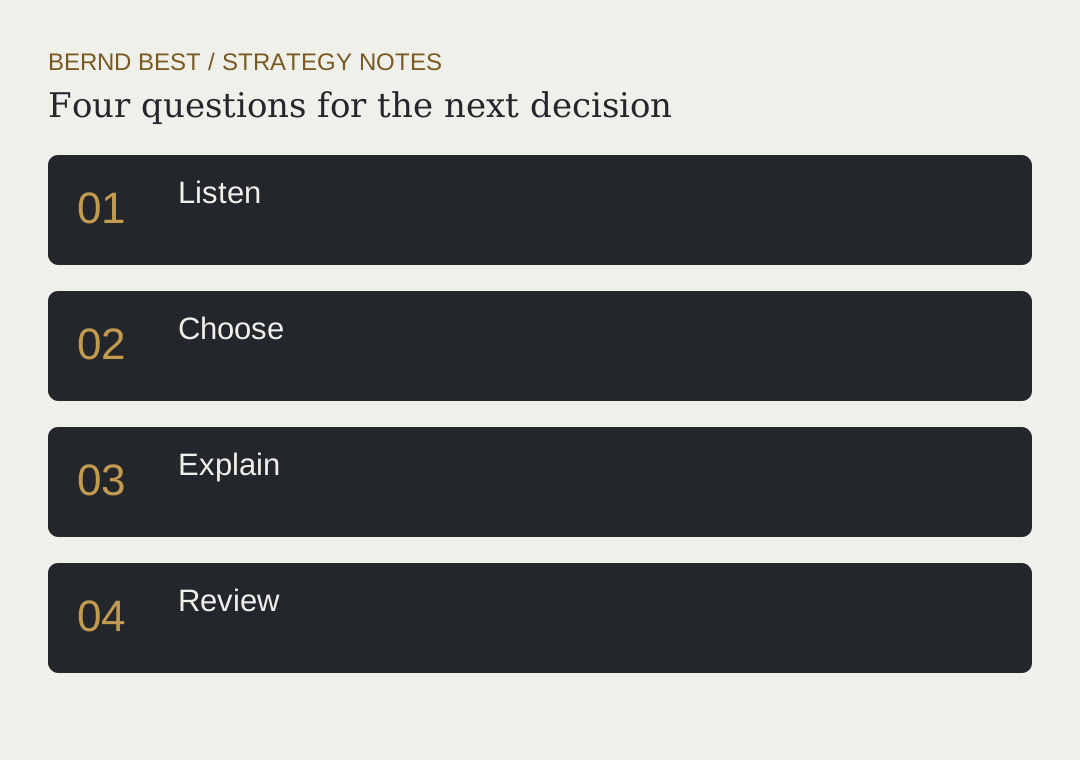
Illustrative case
Illustrative case: a successor notices slow proposal approvals. She does not take every approval into her own hands. With the team, she defines boundaries for standard cases and reviews waiting time and errors. The first change makes the organization more capable rather than trying to prove a new personality.
A practical review
Starting measure: Clearly assigned choices. Specify the unit, source, observation window and owner. Use comparable cases and keep exceptions visible.
| Period | Task | Evidence |
|---|---|---|
| Days 1 to 7 | Clarify listen through one specific case. | A documented observation, not merely agreement. |
| Days 8 to 14 | Examine choose with the responsible people. | An assumption and the evidence still missing. |
| Days 15 to 23 | Test explain within an agreed limit. | Recorded effects, workload and exceptions. |
| Days 24 to 30 | Decide the next step concerning review. | An owner, a date and a stopping rule. |
Use the timetable as a discussion aid and adjust it to the actual decision cycle. A manufacturing investment, a family handover and a short service test do not run on identical clocks. Do not infer improvement from completing tasks alone: check whether the decision became clearer and whether the effect appears in ordinary work. Keep a contrary observation in the review even when it complicates the original story.
US, UK, EU and DACH perspectives
A US lens often emphasizes the operating leadership role; a UK lens distinguishes responsibilities of owners and boards. European and German family businesses add established relationships, legal structures and participation rights. These are questions to examine, not descriptions of every company in a country. Austria and Switzerland have their own corporate, tax and employment frameworks. A handover plan must fit the actual business. Borrow a useful leadership question, but do not import another country’s legal structure without suitable professional review.
Frequently asked questions
How should I examine listen?
Speak with different functions and suitable customers, not only former leadership. Ask about specific situations: where do people wait, where do exceptions arise and which promise is hardest to keep?
How should I examine choose?
Select a bounded improvement with an understandable benefit for buyers or staff. Explain what will remain for now and why.
How should I examine explain?
Check whether decisions actually sit with the intended people. Address returns to old approval paths without dismissing the past.
How should I examine review?
Record choices, assumptions and observations in a simple leadership log. It guards against retrospective stories that everything was obvious.
Which measure belongs in the review?
Begin with clearly assigned choices. Define the observation window, data source and owner before measuring. Compare similar cases, record exceptions and assess effects on customers and workload. The metric is a local learning aid, not a benchmark or guarantee.
When is this approach unsuitable?
Do not use this framework as a substitute for missing facts, a resolved mandate or required specialist review. Begin with one bounded decision. If the work cannot change a next action, narrow the question or choose a more suitable method.
Further reading
These primary sources provide background. The argument, working plan, illustrations and hypothetical case above are original editorial work. Sources checked October 10, 2026.
If a decision in your business still feels unclear, the short strategy check offers a starting point for a conversation. Open the strategy check.