Strategy Journal / 21
Succession and capital: investors also buy the next decision
Topic retrospective: 2026-10-10 · Published and updated: October 10, 2026. Written now; not an archived historical publication.
Succession and investment involve more than historical results. The question is whether the business can continue reliably after a handover. That requires understandable customer value, transferable relationships, suitable leadership and an explainable use of capital. Strategy connects these factors into a reasoned choice about the future.
By Bernd Best · Original editorial analysis · Approximately 8 minutes

The decision
A strong founder can be both a source of success and a dependency. Ignoring that relationship confuses past performance with transferability. Examine the business under different leadership. Clear discussion of risks supports practical conversations without promising a valuation or transaction outcome.
Working through the choice
Connect earnings with capabilities
Identify the activities and relationships that support results. Recurring revenue needs to be understood alongside retention, obligations and delivery capacity. Record which capabilities remain and which must be built. Historical figures alone cannot answer that operating question.
Do not conceal dependencies
Identify significant buyers, key people and special arrangements with appropriate confidentiality. Show how responsibility and knowledge can transfer. Neither dramatize risks nor hide them behind broad reassurance. Investors or successors need to assess consequences while confidentiality and privacy requirements still apply.
Assign capital to a purpose
Distinguish funding for acquisition, operations and development. Paying for ownership does not automatically fund new capabilities. Explain sequence, assumptions and decision boundaries. Financing, tax and legal structure each need appropriate specialist assessment; strategic clarity cannot replace it.
Plan beyond closing
A signed agreement does not finish the handover. Plan customer communication, leadership transfer and early operating decisions. Define observations that will trigger further discussion during the first months. A realistic transition connects the transaction with operations rather than postponing all economic work until afterward.
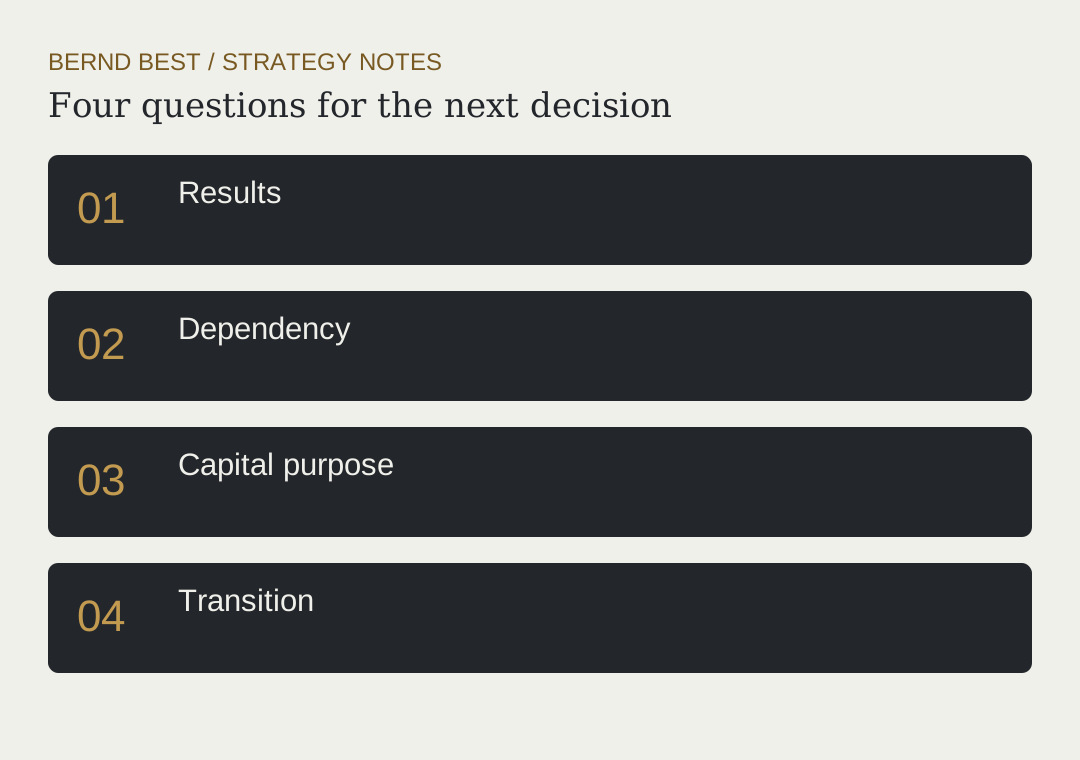
Illustrative case
Illustrative case: a successor considers a specialist business with solid results and substantial owner dependence. She separates acquisition funding from resources for knowledge and customer transfer. The plan names transition roles and an initial review. This makes questions testable without expressing a view on the right purchase price.
A practical review
Starting measure: Transferable responsibility. Specify the unit, source, observation window and owner. Use comparable cases and keep exceptions visible.
| Period | Task | Evidence |
|---|---|---|
| Days 1 to 7 | Clarify results through one specific case. | A documented observation, not merely agreement. |
| Days 8 to 14 | Examine dependency with the responsible people. | An assumption and the evidence still missing. |
| Days 15 to 23 | Test capital purpose within an agreed limit. | Recorded effects, workload and exceptions. |
| Days 24 to 30 | Decide the next step concerning transition. | An owner, a date and a stopping rule. |
Use the timetable as a discussion aid and adjust it to the actual decision cycle. A manufacturing investment, a family handover and a short service test do not run on identical clocks. Do not infer improvement from completing tasks alone: check whether the decision became clearer and whether the effect appears in ordinary work. Keep a contrary observation in the review even when it complicates the original story.
US, UK, EU and DACH perspectives
A US lens often emphasizes the operating leadership role; a UK lens distinguishes responsibilities of owners and boards. European and German family businesses add established relationships, legal structures and participation rights. These are questions to examine, not descriptions of every company in a country. Austria and Switzerland have their own corporate, tax and employment frameworks. A handover plan must fit the actual business. Borrow a useful leadership question, but do not import another country’s legal structure without suitable professional review.
Frequently asked questions
How should I examine results?
Identify the activities and relationships that support results. Recurring revenue needs to be understood alongside retention, obligations and delivery capacity.
How should I examine dependency?
Identify significant buyers, key people and special arrangements with appropriate confidentiality. Show how responsibility and knowledge can transfer.
How should I examine capital purpose?
Distinguish funding for acquisition, operations and development. Paying for ownership does not automatically fund new capabilities.
How should I examine transition?
A signed agreement does not finish the handover. Plan customer communication, leadership transfer and early operating decisions.
Which measure belongs in the review?
Begin with transferable responsibility. Define the observation window, data source and owner before measuring. Compare similar cases, record exceptions and assess effects on customers and workload. The metric is a local learning aid, not a benchmark or guarantee.
When is this approach unsuitable?
Do not use this framework as a substitute for missing facts, a resolved mandate or required specialist review. Begin with one bounded decision. If the work cannot change a next action, narrow the question or choose a more suitable method.
Further reading
These primary sources provide background. The argument, working plan, illustrations and hypothetical case above are original editorial work. Sources checked October 10, 2026.
If a decision in your business still feels unclear, the short strategy check offers a starting point for a conversation. Open the strategy check.