Strategy Journal / 04
Low-budget strategy: inexpensive choices are rarely comfortable
Topic retrospective: 2022-06-06 · Published and updated: October 10, 2026. Written now; not an archived historical publication.
A low-budget strategy reduces the cost of resolving an important uncertainty. It is not a contest to spend the least. Customer interviews, clear service boundaries and a canceled project can require little cash and still matter substantially. The right action depends on the constraint.
By Bernd Best · Original editorial analysis · Approximately 8 minutes

The decision
A small budget often leads to improvised extra work. Cash is saved while time is quietly consumed. Examine external spending, internal capacity and the risk of a wrong decision together. A cheap test is genuinely economical only when all three are visible.
Working through the choice
Name the constraint first
If qualified conversations are missing, another brochure may not help. If orders are lost, the cause may concern the offer or delivery. Select one constraint and one observable effect. Avoid a collection of inexpensive tactics, each supposedly solving a different problem.
Test manually before automating
A bounded manual process can reveal whether a service is wanted. Record time per case and where errors arise. This is a learning phase, not a permanent unpaid exception to be excluded from later economics.
Removing work can be an investment
Review recurring reports, special services and channels without a clear role. The aim is not indiscriminate cuts. Released capacity should visibly move toward a priority. Without that reallocation, cost reduction can exhaust people while leaving the strategic constraint intact.
An effect is not a guarantee
A local test shows what occurred under its conditions. It does not prove worldwide demand. Test a second, meaningfully different setting before scaling. The least expensive useful strategy may be stopping an appealing idea after a negative signal.
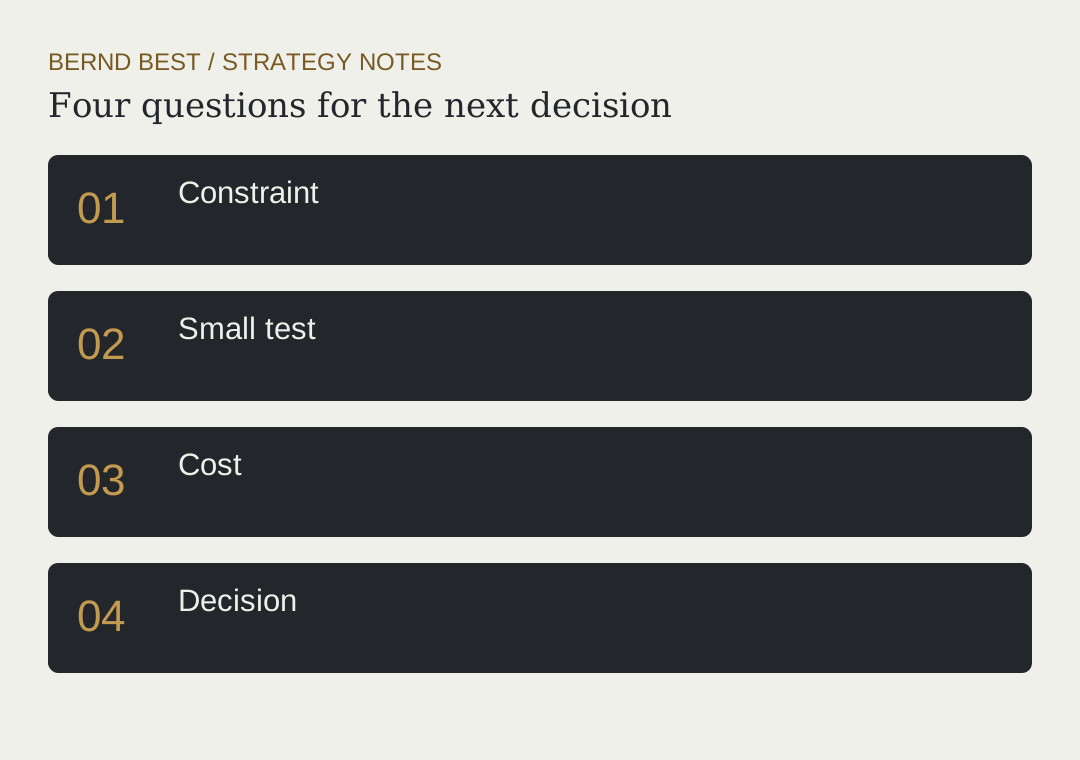
Illustrative case
Illustrative consultancy: five open-ended service variations become two clearly bounded offers. For four weeks, the team records sales time, change requests and contribution per order. The experiment requires no new software, but it does require management time and the willingness to decline unsuitable requests. Its findings remain local observations.
A practical review
Starting measure: Total cost per insight. Specify the unit, source, observation window and owner. Use comparable cases and keep exceptions visible.
| Period | Task | Evidence |
|---|---|---|
| Days 1 to 7 | Clarify constraint through one specific case. | A documented observation, not merely agreement. |
| Days 8 to 14 | Examine small test with the responsible people. | An assumption and the evidence still missing. |
| Days 15 to 23 | Test cost within an agreed limit. | Recorded effects, workload and exceptions. |
| Days 24 to 30 | Decide the next step concerning decision. | An owner, a date and a stopping rule. |
Use the timetable as a discussion aid and adjust it to the actual decision cycle. A manufacturing investment, a family handover and a short service test do not run on identical clocks. Do not infer improvement from completing tasks alone: check whether the decision became clearer and whether the effect appears in ordinary work. Keep a contrary observation in the review even when it complicates the original story.
US, UK, EU and DACH perspectives
A US lens may focus attention on buyer access and credible experiments; a UK lens can highlight governance and accountable decisions. An EU or German perspective adds the actual legal, industry and relationship context. These are useful questions, not national traits or a ranking. Austria and Switzerland warrant the same operating examination alongside their own local conditions. Begin with buyers, delivery and the constraint. Adopt a framework only if it makes a concrete choice easier to understand.
Frequently asked questions
How should I examine constraint?
If qualified conversations are missing, another brochure may not help. If orders are lost, the cause may concern the offer or delivery.
How should I examine small test?
A bounded manual process can reveal whether a service is wanted. Record time per case and where errors arise.
How should I examine cost?
Review recurring reports, special services and channels without a clear role. The aim is not indiscriminate cuts.
How should I examine decision?
A local test shows what occurred under its conditions. It does not prove worldwide demand.
Which measure belongs in the review?
Begin with total cost per insight. Define the observation window, data source and owner before measuring. Compare similar cases, record exceptions and assess effects on customers and workload. The metric is a local learning aid, not a benchmark or guarantee.
When is this approach unsuitable?
Do not use this framework as a substitute for missing facts, a resolved mandate or required specialist review. Begin with one bounded decision. If the work cannot change a next action, narrow the question or choose a more suitable method.
Further reading
These primary sources provide background. The argument, working plan, illustrations and hypothetical case above are original editorial work. Sources checked October 10, 2026.
If a decision in your business still feels unclear, the short strategy check offers a starting point for a conversation. Open the strategy check.