Strategy Journal / 09
Scenario planning: stay useful when the forecast is wrong
Topic retrospective: 2024-01-15 · Published and updated: October 10, 2026. Written now; not an archived historical publication.
Scenario planning prepares choices for different plausible developments. It replaces neither forecasting nor operating plans. Its value is identifying actions that work across conditions and observable signals that would justify a different choice. A few distinct scenarios are more useful than many nearly identical spreadsheets.
By Bernd Best · Original editorial analysis · Approximately 8 minutes

The decision
An annual plan can look precise while depending on one future. Later customer orders or the loss of a key supplier then turn every deviation into an emergency. Separate the desired result from the possible environment. Plan the choices that would follow a change, not merely the numbers.
Working through the choice
Distinguish uncertainty from fluctuation
Ordinary revenue variation can often be represented by a range. A change in major customers’ purchasing logic may challenge the model itself. Choose two uncertainties whose combination produces different decisions, such as demand and supply availability. Two axes are a thinking tool, not scientific proof of complete coverage.
Make each future concrete
Describe an ordinary order under each scenario. Who buys, when does cash arrive and where does a constraint emerge? This makes differences operationally understandable. A story about one buyer and one delivery can expose more inconsistencies than an assumption of ten percent lower revenue.
Separate robust actions from options
Better visibility of payment terms may help across scenarios. A new production line may pay off in only one. Begin with robust actions and stage expensive options where economically appropriate. Record the cost of waiting: deferral is also a decision with consequences.
Assign responsibility for signals
Each signal needs a source, a review rhythm and an owner. Decide when longer proposal cycles, for example, should trigger reconsideration. Avoid reacting mechanically to isolated spikes. The owner checks data quality and context before recommending a change to leadership.
Illustrative case
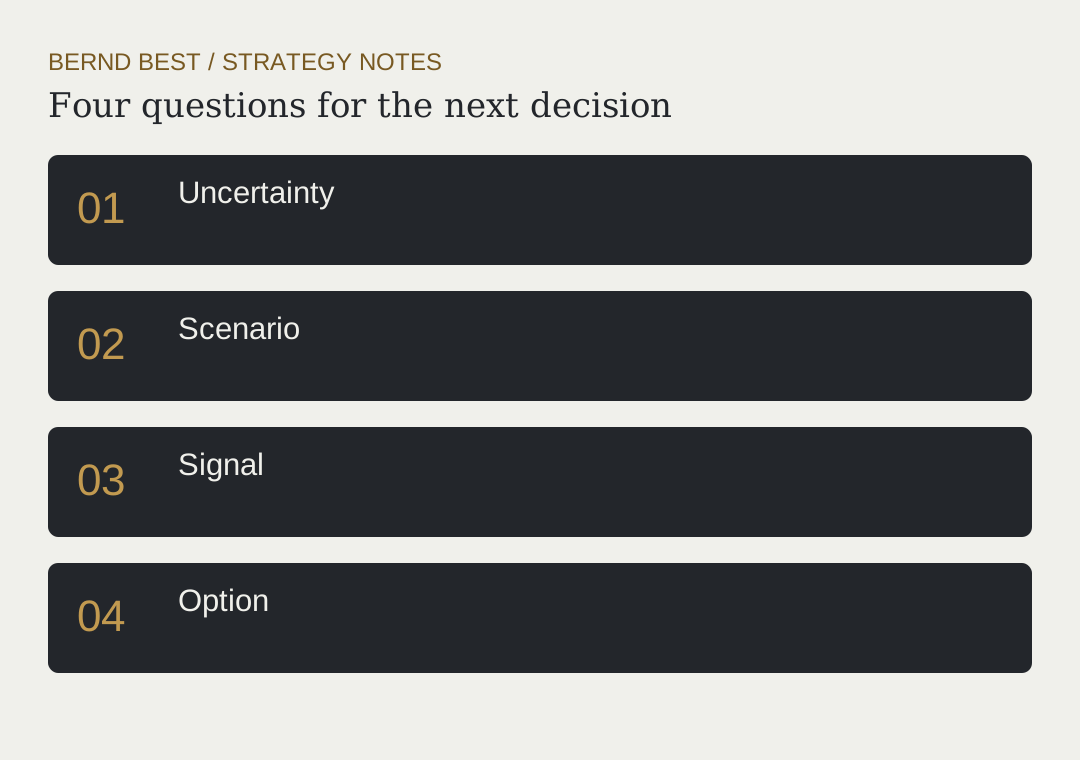
Illustrative case: a supplier considers steady or delayed demand alongside reliable or disrupted sourcing. It improves visibility of critical parts in all four settings. Capacity expansion, however, depends on verified call-offs and financing review. The team knows in advance when to reopen the investment decision.
A practical review
Starting measure: Time from signal to choice. Specify the unit, source, observation window and owner. Use comparable cases and keep exceptions visible.
| Period | Task | Evidence |
|---|---|---|
| Days 1 to 7 | Clarify uncertainty through one specific case. | A documented observation, not merely agreement. |
| Days 8 to 14 | Examine scenario with the responsible people. | An assumption and the evidence still missing. |
| Days 15 to 23 | Test signal within an agreed limit. | Recorded effects, workload and exceptions. |
| Days 24 to 30 | Decide the next step concerning option. | An owner, a date and a stopping rule. |
Use the timetable as a discussion aid and adjust it to the actual decision cycle. A manufacturing investment, a family handover and a short service test do not run on identical clocks. Do not infer improvement from completing tasks alone: check whether the decision became clearer and whether the effect appears in ordinary work. Keep a contrary observation in the review even when it complicates the original story.
US, UK, EU and DACH perspectives
A US lens may focus attention on buyer access and credible experiments; a UK lens can highlight governance and accountable decisions. An EU or German perspective adds the actual legal, industry and relationship context. These are useful questions, not national traits or a ranking. Austria and Switzerland warrant the same operating examination alongside their own local conditions. Begin with buyers, delivery and the constraint. Adopt a framework only if it makes a concrete choice easier to understand.
Frequently asked questions
How should I examine uncertainty?
Ordinary revenue variation can often be represented by a range. A change in major customers’ purchasing logic may challenge the model itself.
How should I examine scenario?
Describe an ordinary order under each scenario. Who buys, when does cash arrive and where does a constraint emerge?
How should I examine signal?
Better visibility of payment terms may help across scenarios. A new production line may pay off in only one.
How should I examine option?
Each signal needs a source, a review rhythm and an owner. Decide when longer proposal cycles, for example, should trigger reconsideration.
Which measure belongs in the review?
Begin with time from signal to choice. Define the observation window, data source and owner before measuring. Compare similar cases, record exceptions and assess effects on customers and workload. The metric is a local learning aid, not a benchmark or guarantee.
When is this approach unsuitable?
Do not use this framework as a substitute for missing facts, a resolved mandate or required specialist review. Begin with one bounded decision. If the work cannot change a next action, narrow the question or choose a more suitable method.
Further reading
These primary sources provide background. The argument, working plan, illustrations and hypothetical case above are original editorial work. Sources checked October 10, 2026.
If a decision in your business still feels unclear, the short strategy check offers a starting point for a conversation. Open the strategy check.